AEROSPACE TECHNOLOGIES
Your browser is not supported.
For the best experience, please access this site using the latest version of the following browsers:



By closing this window you acknowledge that your experience on this website may be degraded.
Why PTMS is foundational to F-35 Mission Success
Inside the cockpit: Why PTMS is foundational to F-35 Mission Success
In modern air combat, success starts long before an aircraft leaves the runway, and for F-35 pilots and the commanders responsible for generating combat-ready squadrons, one truth remains constant: reliability is everything.
To understand what this looks like in real-world operations, we spoke with U.S. Marine Corps Colonel (ret.) Ben Hutchins, a former commander of Marine Aircraft Group 13 and F-35B pilot with staff assignments at the Joint Staff J8 and the F-35 Joint Program Office. Now serving as the Global Government Relations Defense Lead at Honeywell Aerospace, Hutchins explained the role of the Power and Thermal Management System (PTMS) and why it is foundational to mission success.
Reliability: The foundation of combat power
Reliability is the cornerstone of military aviation power projection. Units must demonstrate proficiency in their directed mission sets, requiring available assets both in peacetime training and wartime combat missions. A reliable and sustainable product forms the bedrock of aviation readiness, enabling strategic global power projection.
At the center of reliability for the F-35 is a system most people never see, but every pilot depends on, the PTMS.
The system that powers and protects the aircraft
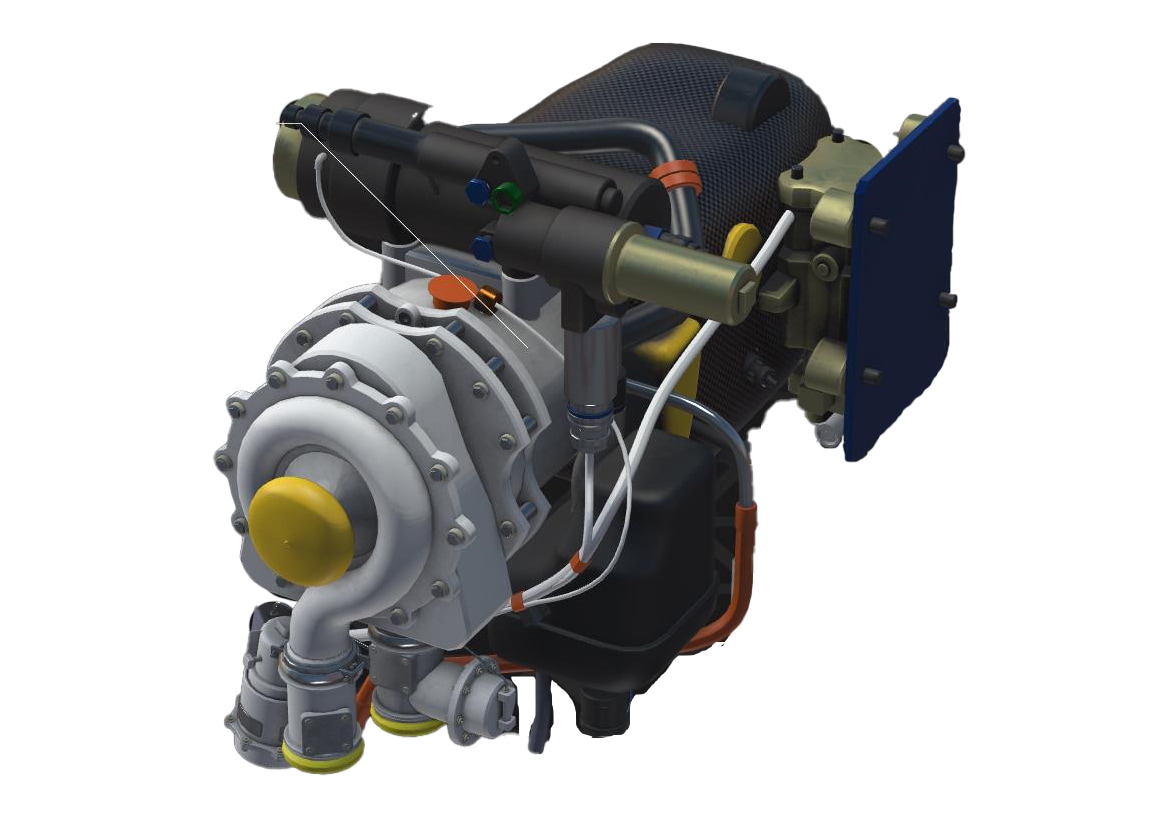
The PTMS combines all functions of an auxiliary power unit, emergency power unit, environmental control system, and thermal management system into one highly integrated package. It supplies liquid and air cooling for multiple F-35 mission systems like the radar, electronic warfare system, and avionics.
But its role goes far beyond performance.
The PTMS also performs many safety-critical functions, such as those that cool and pressurize the cockpit, provide oxygen to the pilot, seal and defog the canopy, inert the fuel tanks, supply emergency power to primary flight controls if the main engine or generators fail, and supply ram air cooling to the cockpit and air-cooled avionics to enable a safe landing during an in-flight emergency.
Without PTMS, the mission doesn’t just degrade; it stops.
Trust between pilot and machine
For a pilot, trust in the aircraft is not optional, it is survival.
In combat, aircrew rely on a trusted system to not only perform the mission, but to get them home. System comprehension and mastery is key to mission effectiveness.
Pilots who fully understand their aircraft make informed risk decisions in degraded operations, whether dealing with mechanical failures or combat damage. That level of understanding is critical in a platform like the F-35, which relies heavily on the PTMS to safely and effectively operate its advanced mission systems.
The PTMS performs multiple critical functions in the F-35 and forms the heart of the thermal management system. The F-35, more than legacy fighter aircraft, is heavily reliant the PTMS to balance the thermal loads of its fifth-generation mission systems.
Mission readiness starts with proven systems
From an operational perspective, the impact of PTMS is straightforward.
Simply stated, without it, the mission can’t progress. From cooling advanced mission systems to supplying conditioned air to pilots, the PTMS is essential to every successful F-35 test, training, and combat sortie.
That kind of reliability translates directly into readiness. When systems are proven, predictable, and understood, squadrons can sustain operations, maintain tempo, and execute missions without disruption.
Scaling to meet the demands of the future fight
As the F-35 evolves, so do the demands placed on its core systems.
The PTMS was architected to scale with those demands. Honeywell’s Performance Software Upgrade (PSU) provides a 25% cooling capacity boost to 40kW for initial post-Block 4 mission system upgrades, while reducing engine bleed air usage by up to 41% to cut F135 overhaul costs.
Coupling PSU with low-risk hardware upgrades further scales PTMS cooling capacity to 62-80kW, as needed to fully support all planned mission system upgrades.
With scalable PTMS upgrades, Honeywell provides tailored options across the F-35 fleet. U.S. and international partners maintain flexibility to cost-effectively increase cooling capacity in alignment with new mission system heat loads.
Combat-Proven, Upgrade-Ready
At the end of the day, the requirement is simple. A predictable outcome achieved by a combat-tested and proven system. The PTMS is—and will continue to be—the gold standard for F-35 power and thermal management.
From the flightline to the battlespace, one principle holds true: systems that are tested, trusted, and understood are the ones that deliver.
For F-35, the PTMS is not just a supporting system. It is the cornerstone of performance, safety, and mission success.
Combat-Proven, Upgrade- Ready
PTMS: the cornerstone of performance, safety, and mission success
Let's Connect!
The latest news in aerospace backed by expert insights
Sign up to receive the latest news about events, special offers and related topics via email and other forms of electronic communication.